All refund types
GST refund services
All refund types in one place.
View service
GST Refund Services
In short: a Letter of Undertaking (LUT) in Form GST RFD-11 is what lets you export goods or services, or supply to an SEZ, without paying IGST. You furnish it to the jurisdictional Commissioner before you export, and in it you undertake to pay the tax with interest if the goods are not exported, or the payment for services is not received, within the time the rule allows.

Rule 96A
Any registered person who wants to supply goods or services for export without payment of integrated tax must furnish a bond or an LUT in Form GST RFD-11 to the jurisdictional Commissioner prior to export (rule 96A(1)). The same applies to zero-rated supplies to an SEZ developer or SEZ unit made without IGST (rule 96A(6)).
An exporter who does this can then claim refund of the unused input tax credit (IGST Act s.16(3)). That refund is a separate task, covered on our page on refunds of exports under LUT.
Or starting to supply to an SEZ.
You export regularly and your current LUT needs to be replaced. The LUT is furnished for a financial year, so a new one is filed for each year (Notification 37/2017-Central Tax, paragraph (ii)).
You exported without IGST before your LUT was accepted, and need the delay condoned.
You do not need one for exports of exempt or non-GST goods: CBIC has clarified that an LUT or bond cannot be insisted on for those, and the refund of unused credit is still available (Circular 125/44/2019-GST, paragraph 49).
Eligibility
Rule 96A allows either a bond or an LUT, and lets the Board specify the conditions and safeguards under which an LUT may be furnished instead of a bond (rule 96A(5)). CBIC's refund circular explains that the LUT facility is available to all exporters under Notification 37/2017-Central Tax, except those who have been prosecuted for an offence under the CGST Act, the IGST Act or the earlier laws where the tax evaded exceeds ₹250 lakh. Those who are not eligible must export under a bond (Circular 125/44/2019-GST, paragraph 46).
| LUT | Bond | |
|---|---|---|
| Who uses it | All exporters, except those prosecuted where tax evaded exceeds ₹250 lakh | Exporters not eligible for an LUT |
| Form | GST RFD-11 | GST RFD-11 |
| Security | Undertaking only | A running bond covering the self-assessed estimated tax on exports, with a bank guarantee that should normally not exceed 15% of the bond amount (Circular 8/8/2017-GST, paragraph 2(f)-(g)) |
| Self-declaration on prosecution | Given once, when the LUT is submitted | Not applicable |
One declaration, not one per claim. The self-declaration that you have not been prosecuted is given when the LUT is submitted (Circular 8/8/2017-GST, paragraph 2(d)). It is not needed again with every refund claim (Circular 125/44/2019-GST, paragraph 46).
The undertaking
By furnishing the LUT you bind yourself to pay the tax due, with interest under section 50(1), within these periods (rule 96A(1), as substituted by Notification 12/2024-Central Tax):
From the date of the export invoice, or such further period as the Commissioner allows.
From the date of the export invoice, including any RBI extension of the FEMA period, or such further period as the Commissioner allows, if payment is not received in convertible foreign exchange, or in Indian rupees where the RBI permits.
Where the goods are not exported in time and the amount is not paid, the facility to export under the LUT is withdrawn forthwith and the amount is recovered under section 79 (rule 96A(3)). The facility is restored immediately once the amount due is paid (rule 96A(4)). A single missed deadline withdraws the LUT, and every later export then needs IGST until the amount is paid.
CBIC has said that, since exports are zero-rated, where goods are actually exported after the three months, the exporter should not be made to pay IGST first and claim it back later. The Commissioner may extend the time after the event, on the facts. The same principle applies to services (Circular 125/44/2019-GST, paragraph 45).
Condonation
If exports were made before the LUT was furnished, CBIC has said the substantive benefit of zero rating should not be denied where the exports are established. The delay in furnishing the LUT may be condoned and the LUT facility allowed ex post facto, taking into account the facts and circumstances (Circular 125/44/2019-GST, paragraph 44). This is a request to the jurisdictional officer, not an automatic right, so it should be made with the export documents, as soon as the gap is found.
Eight steps
Rather than a bond: the prosecution condition (Circular 125/44/2019-GST, paragraph 46).
Legal name, address, authorised signatory and bank details, because the LUT is tied to the GSTIN.
The period the LUT is to cover, and whether an earlier LUT is in place.
With the undertaking, the self-declaration on prosecution and the details the form asks for.
And sign it with DSC or EVC.
And note the LUT reference on your export invoices as your practice requires.
For every export invoice under the LUT, we record the three-month (goods) or one-year/FEMA (services) date plus 15 days, and alert you before it arrives.
Apply to the Commissioner for more time, or pay the tax with interest before the LUT is withdrawn.
Three cases
The dates below are illustrations chosen to show how the rules work. They are not client cases.
The invoice is raised without IGST.
The goods have not been shipped. Unless the Commissioner allows more time, the undertaking bites.
IGST on the invoice, with interest under section 50(1), must be paid within 15 days.
If it is not paid, the LUT is withdrawn and all later exports need IGST until the amount is paid (rule 96A(1)(a), (3), (4)).
The same goods are shipped on 2 May. Under CBIC's guidance, the exporter can ask the Commissioner to extend the time after the event instead of paying IGST and claiming it back (Circular 125/44/2019-GST, paragraph 45).
An invoice for export of services under LUT is dated 1 June 2025. The one-year period ends on 1 June 2026, so the undertaking bites on 16 June 2026, unless the FEMA period (with any RBI extension) ends later, in which case the later date applies. If payment arrives in foreign exchange before then, no tax is payable (rule 96A(1)(b)).
The chain
An LUT is only the first link in a chain. Each later step depends on it:
Each invoice for a supply made under the LUT is raised without IGST. Each such invoice carries this endorsement (CGST Rules rule 46):
Supply meant for export / supply to SEZ unit or SEZ developer for authorised operations under bond or Letter of Undertaking without payment of integrated taxThe export invoices are reported in GSTR-1 (as amended in GSTR-1A, if any). For goods, those details are sent electronically to the customs system, which sends back confirmation that the goods were exported (rule 96A(2)).
The same undertaking covers zero-rated supplies to SEZ developers and units without IGST (rule 96A(6)). The refund on those also needs the SEZ officer's endorsement; see refunds on SEZ supplies.
When you later claim refund of the unused credit, the officer checks that the exports in the claim were made under a valid LUT. An export made before the LUT was furnished is the most common reason a part of the claim is questioned (Circular 125/44/2019-GST, paragraph 44).
For goods, if sale proceeds are not realised within the FEMA period, a refund already received has to be repaid with interest within 30 days (rule 96B). For services, non-receipt of payment within the rule 96A period triggers the undertaking itself.
One tracker per GSTIN. We keep these links in one tracker per GSTIN, so an export invoice can be followed from the LUT to the refund.
Checklist
Watch for these
Scope
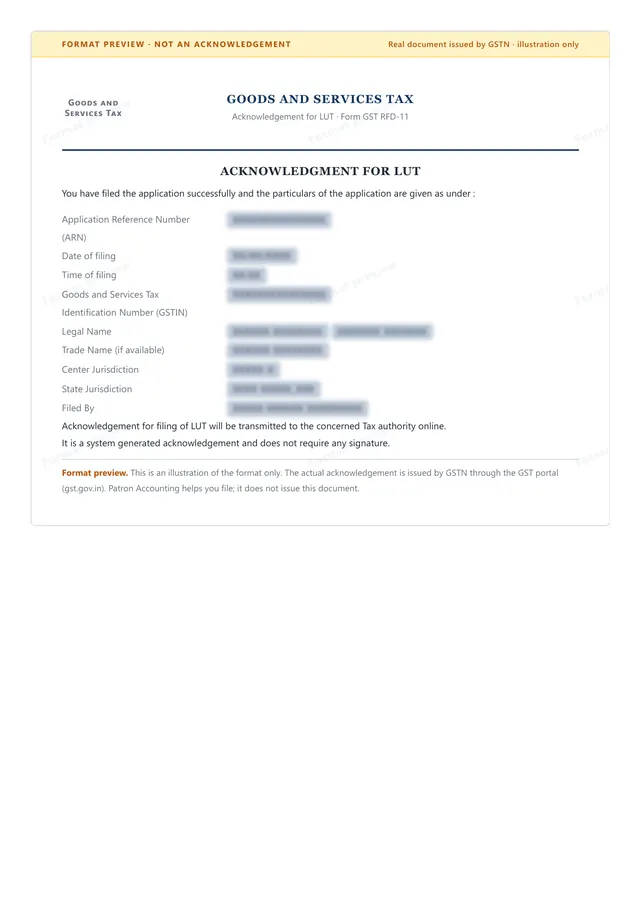
See a sample
LUT acknowledgement (RFD-11)
The acknowledgement for a Letter of Undertaking (Form GST RFD-11) filed by an exporter.
Values hidden for privacy. Names, numbers and dates are covered. Your own document carries your details.
Download LUT acknowledgement (RFD-11) sample (PDF) View LUT acknowledgement (RFD-11) sample
Fees
LUT filing
Bond and bank guarantee work is quoted separately.
Quality
Before the RFD-11 is signed, and each month after it, a second person checks:
Regulatory statements on this page are taken from the IGST and CGST Acts and Rules and CBIC circulars, and are reviewed by CA Sundram Gupta.
Subham Jhunjhunwala, reviewed by CA Sundram Gupta
Get a quote
Tell us your GSTIN and what you export. We will check your eligibility, file the RFD-11 and set up your deadline tracker.
Leave your details and we will call you back.
By sending this form you agree to our privacy policy.
Sources used on this page