In this guide
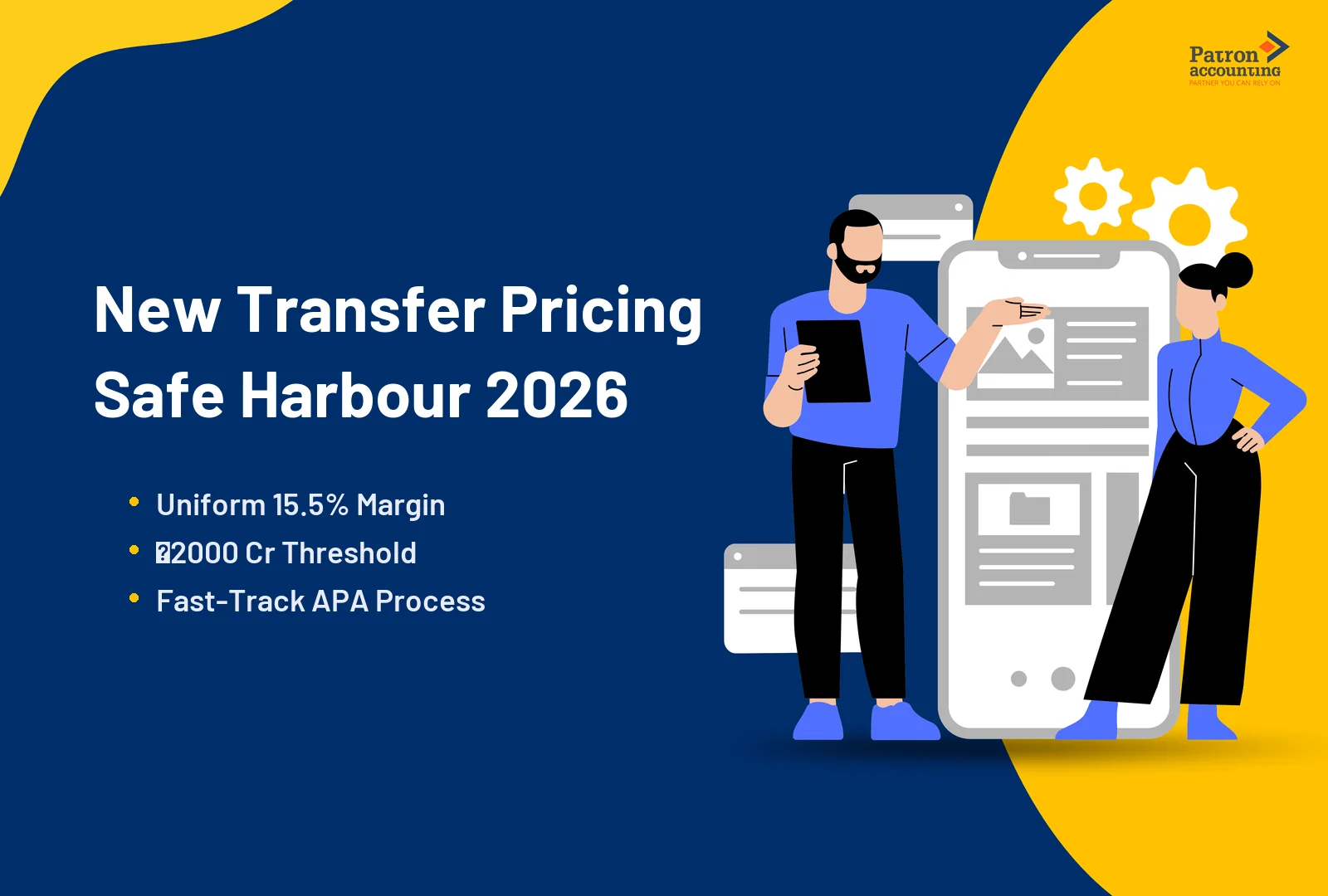
For over a decade, India’s transfer pricing safe harbour rules were a good idea with poor execution. Margins of 20-22% in 2013 were so far above commercial reality that most IT companies rejected safe harbour entirely and pursued costly Advance Pricing Agreements or litigation instead. Budget 2026 has finally reset the framework: a uniform 15.5% margin on operating expenses, a threshold increase from Rs 300 crore to Rs 2,000 crore, automated approval without officer intervention, and 5-year validity.
This guide explains who qualifies, how the consolidated IT services category works, the step-by-step opt-in process, and how the new safe harbour compares with APAs and benchmarking studies.
What Is Transfer Pricing Safe Harbour and Why Does It Matter?
Transfer pricing safe harbour is a mechanism under Section 92CB of the Income Tax Act, 1961 (corresponding provision under IT Act 2025) where the tax authorities agree to accept the transfer price declared by a taxpayer for specified international transactions, provided the taxpayer meets pre-defined profit margin criteria. If the safe harbour conditions are met, the taxpayer’s transfer pricing is not subject to further scrutiny by the Transfer Pricing Officer (TPO).
For Indian IT companies providing services to their overseas associated enterprises (parent companies, group entities), safe harbour eliminates the need for expensive benchmarking studies, documentation, and potential audits. Instead of proving that the transfer price is at arm’s length through comparability analysis, the company simply demonstrates that its operating profit margin meets or exceeds the prescribed threshold.
Companies filing ITR for companies with international transactions can now opt for safe harbour as a simpler alternative to full transfer pricing documentation.
Key Terms You Should Know
- Safe Harbour (SH): Pre-defined profit margin accepted by tax authorities without scrutiny. If you meet the margin, your transfer pricing is deemed arm’s length.
- Transfer Pricing Officer (TPO): The officer who examines international transactions and determines whether the transfer price is at arm’s length. Safe harbour bypasses TPO scrutiny.
- Associated Enterprise (AE): Related party in another country with whom the taxpayer has international transactions (parent company, subsidiary, group entity).
- Operating Profit Margin (OPM): Operating profit as a percentage of operating expenses. The 15.5% safe harbour margin means: operating profit ≥ 15.5% of total operating costs.
- Advance Pricing Agreement (APA): A forward-looking contract between the taxpayer and tax authorities on transfer pricing methods. More expensive and time-consuming than safe harbour but provides certainty for complex transactions.
- Cost-Plus Method: Transfer pricing method where the price is determined by adding a markup to the costs incurred. The 15.5% is essentially a cost-plus markup.
- Information Technology Services: The new consolidated category under Budget 2026 covering software development, ITeS, KPO, and contract R&D relating to software. Replaces four separate categories.
Which Companies Can Opt for the New Safe Harbour?
The reformed safe harbour is designed for companies providing IT-related services to overseas associated enterprises.
- Software development companies providing custom or product-based development services to overseas parent/group companies
- IT-enabled services (ITeS) providers - back-office processing, call centres, data management, technical support
- Knowledge Process Outsourcing (KPO) units - analytics, research, legal process outsourcing, financial modelling
- Contract R&D centres for software development - captive R&D units of multinational companies
- Global Capability Centres (GCCs) performing IT and business process functions for their overseas headquarters
- Mid-sized and large IT firms with international transaction values up to Rs 2,000 crore per year
Companies must maintain proper tax audit services documentation and ensure their operating profit margin meets or exceeds 15.5% of operating expenses to qualify.
Evolution of Safe Harbour Margins: 2013 to 2026
| Period | Software Dev | ITeS | KPO | Contract R&D | Threshold |
|---|---|---|---|---|---|
| 2013-2016 | 20% | 20-22% | 25% | 24-29% | Rs 100-200 Cr |
| 2017-2025 | 17% | 17-18% | 18% | 24% | Rs 300 Cr |
| From April 2026 | 15.5% (consolidated) | 15.5% (consolidated) | 15.5% (consolidated) | 15.5% (consolidated) | Rs 2,000 Cr |
Note: The progressive reduction from 20-29% to 15.5% reflects the government’s alignment with commercial reality. Most APA settlements for IT services were in the 15-17% range. The 15.5% rate is designed to make safe harbour genuinely attractive for the first time.
How to Opt for Safe Harbour: Step-by-Step Process
- Verify eligibility. Confirm that your company provides services under the “Information Technology Services” category (software development, ITeS, KPO, or contract R&D for software) to an overseas associated enterprise. International transaction value must not exceed Rs 2,000 crore.
- Calculate your operating profit margin. OPM = Operating Profit ÷ Operating Expenses × 100. Ensure OPM is at least 15.5%. Include all costs attributable to the IT services in operating expenses. Exclude extraordinary items and non-operating income.
- File the safe harbour application. Under the new automated rule-based system, file the application through the Income Tax e-Filing portal. No manual examination by a tax officer is required. The system validates eligibility based on declared data.
- Obtain the accountant’s certificate. A chartered accountant must certify that the company meets the safe harbour conditions, including the 15.5% OPM threshold. The IT Rules 2026 have rationalised the definition of ‘accountant’ to enable more local firms to issue this certificate.
- Opt in for 5 consecutive years. Once approved, the safe harbour applies for 5 consecutive tax years. No annual re-application is needed. This provides long-term certainty for financial planning and intercompany pricing.
- Maintain transfer pricing documentation. Even under safe harbour, maintain basic TP documentation including the master file and local file. While the TPO will not scrutinise your pricing, documentation is required in case of any future audit or regime change.
- File ITR-6 with TP schedules. Report international transactions in the ITR-6 with appropriate TP schedules. Indicate safe harbour opted status. Refer to our ITR-6 filing guide for the complete corporate return process.
Documents and Records Needed for Safe Harbour
- Audited financial statements showing operating profit and operating expenses
- Transfer pricing master file and local file
- Intercompany service agreements with overseas associated enterprises
- Cost allocation methodology documentation
- Chartered accountant’s certificate certifying safe harbour conditions
- Form 3CEB (TP audit report) filed with the ITR
- Safe harbour application filed on the e-Filing portal
- Details of international transaction values (must not exceed Rs 2,000 crore)
- Functional analysis of services provided to AEs
Safe Harbour vs APA vs Benchmarking Study: Key Differences
| Parameter | Safe Harbour (2026) | Advance Pricing Agreement | Benchmarking Study |
|---|---|---|---|
| Margin / Method | 15.5% of operating expenses (fixed) | Negotiated with tax authority (varies) | Determined by comparability analysis |
| Certainty | High - no TPO scrutiny if conditions met | Very high - binding agreement | Low - subject to TPO challenge |
| Cost to Company | Low - CA certificate + basic documentation | High - APA fees + consultant + negotiation | Moderate - annual benchmarking study |
| Timeline | Automated approval (days/weeks) | Fast-track: 2 years for IT services | Annual - prepared each year |
| Validity | 5 consecutive years | 5-9 years (with rollback) | 1 year (repeated annually) |
| Dispute Risk | Minimal - TPO cannot question if conditions met | None during validity | High - TPO may disagree with comparables |
| Best For | Routine IT services, GCCs, mid-sized exporters | Complex transactions, high-value, bespoke services | Companies not eligible for SH or APA |
Common Mistakes to Avoid with Safe Harbour
Mistake 1: Assuming safe harbour is mandatory. Safe harbour is optional. Companies may choose to continue with benchmarking studies or pursue APAs. However, for routine IT services, safe harbour at 15.5% is now the most cost-effective option.
Mistake 2: Miscalculating operating profit margin. The 15.5% margin is on operating expenses, not on revenue. OPM = Operating Profit ÷ Operating Expenses × 100. If your operating expenses are Rs 100 crore, you must show at least Rs 15.5 crore in operating profit. Errors in cost classification (including non-operating items) can push the margin below threshold.
Mistake 3: Not distinguishing between the Rs 2,000 crore threshold and actual margins. The Rs 2,000 crore limit refers to the aggregate value of international transactions in the IT services category. It does not mean revenue. A company with Rs 3,000 crore revenue but Rs 1,800 crore in eligible international transactions qualifies.
Mistake 4: Ignoring the 5-year commitment. Once you opt for safe harbour, it applies for 5 consecutive years. If your margins drop below 15.5% in a subsequent year, you may face compliance issues. Model your cost projections before opting in.
Mistake 5: Not maintaining TP documentation despite safe harbour. Safe harbour reduces scrutiny but does not eliminate documentation requirements. Maintain master file, local file, and Form 3CEB. If the safe harbour is ever challenged or withdrawn, documentation protects your position.
Penalties and Consequences of Transfer Pricing Non-Compliance
Companies that do not opt for safe harbour and fail to maintain arm’s length pricing face significant penalties.
Under Section 92C, the TPO can make an adjustment to the transfer price, which increases taxable income. The adjustment attracts tax at the applicable corporate rate (25% or 22% under Section 115BAA).
Under Section 271BA, failure to file Form 3CEB (TP audit report) attracts a penalty of Rs 1 lakh.
Under Section 271G, failure to maintain or furnish TP documentation attracts a penalty of 2% of the value of the international transaction.
Under Section 270A, TP adjustments treated as under-reporting attract 50% penalty; misreporting attracts 200% penalty on the tax amount.
Safe harbour eliminates all of these risks for qualifying transactions by removing TPO scrutiny entirely.
How Safe Harbour Connects with Data Centres, Bonded Warehouses, and GCCs
Budget 2026 introduced two additional safe harbour categories alongside the IT services overhaul.
For data centre services, a cost-based safe harbour margin of 15% applies to Indian entities providing data centre infrastructure services to overseas associated enterprises where the foreign enterprise uses those services to offer cloud solutions to international customers. This targets multinational cloud providers (AWS, Azure, Google Cloud) operating through Indian data centres. A tax holiday until 2047 further incentivises this setup.
For bonded warehouse operations, a 2% safe harbour margin on invoice value applies to non-residents warehousing components in Indian bonded warehouses for electronics manufacturing. This supports the just-in-time logistics model for “Make in India” electronics.
For Global Capability Centres (GCCs), the consolidated IT services safe harbour at 15.5% is directly applicable. GCCs performing software development, analytics, or business process functions for their overseas headquarters can now opt for safe harbour up to Rs 2,000 crore in transaction value, avoiding costly benchmarking and TPO disputes.
Companies setting up new operations in India should evaluate safe harbour eligibility at the time of company registration to build compliant intercompany pricing from day one.
Worked Example: Safe Harbour vs Benchmarking for a Rs 500 Crore IT Company
| Parameter | With Safe Harbour | Without (Benchmarking) |
|---|---|---|
| Operating Expenses | Rs 500 crore | Rs 500 crore |
| Required Minimum OPM | 15.5% = Rs 77.5 crore profit | TPO may demand 17-18% = Rs 85-90 crore |
| Revenue to AE | Rs 577.5 crore (cost + 15.5%) | Rs 585-590 crore (if TPO prevails) |
| Tax on Profit (22% + cess) | Rs 19.4 crore | Rs 21.3-22.5 crore (if adjusted upward) |
| TP Documentation Cost | Minimal - CA certificate, basic filings | Rs 15-30 lakh annually (benchmarking study) |
| Dispute Risk | Nil - TPO cannot adjust | High - TPO may propose adjustment, leading to appeal |
| Certainty Period | 5 years locked | Annual reassessment |
Net benefit of safe harbour: Lower minimum margin (15.5% vs potential 17-18% TPO demand), no benchmarking study cost, zero dispute risk, and 5-year certainty. For a Rs 500 crore IT company, this can save Rs 2-3 crore per year in tax and compliance costs combined.
Key Takeaways
Budget 2026 has consolidated software development, ITeS, KPO, and contract R&D into a single “Information Technology Services” category with a uniform safe harbour margin of 15.5% of operating expenses, effective from Tax Year 2026-27.
The eligibility threshold has been raised from Rs 300 crore to Rs 2,000 crore, bringing mid-sized and larger IT companies into the safe harbour net for the first time.
Approval is automated and rule-based - no manual examination by a tax officer. Once opted in, the safe harbour is valid for 5 consecutive years, providing long-term pricing certainty.
For IT companies pursuing APAs instead, Budget 2026 introduces a fast-track unilateral APA mechanism with a 2-year completion target (extendable by 2 months). Modified returns are available for associated entities entering APAs.
Additional safe harbour categories include data centres at 15% of cost (with tax holiday until 2047) and bonded warehouse operations at 2% of invoice value, supporting India’s cloud infrastructure and electronics manufacturing ambitions.
Need Help with Transfer Pricing and Safe Harbour?
The safe harbour overhaul provides meaningful relief, but opting in requires correct OPM calculation, proper documentation, and alignment of intercompany pricing with the 15.5% threshold. For companies with complex service mixes or those near the margin boundary, expert guidance ensures compliance without over-declaring income.
Explore our corporate tax filing for assistance with safe harbour application, Form 3CEB preparation, ITR-6 filing with TP schedules, and ongoing transfer pricing compliance.