In this guide
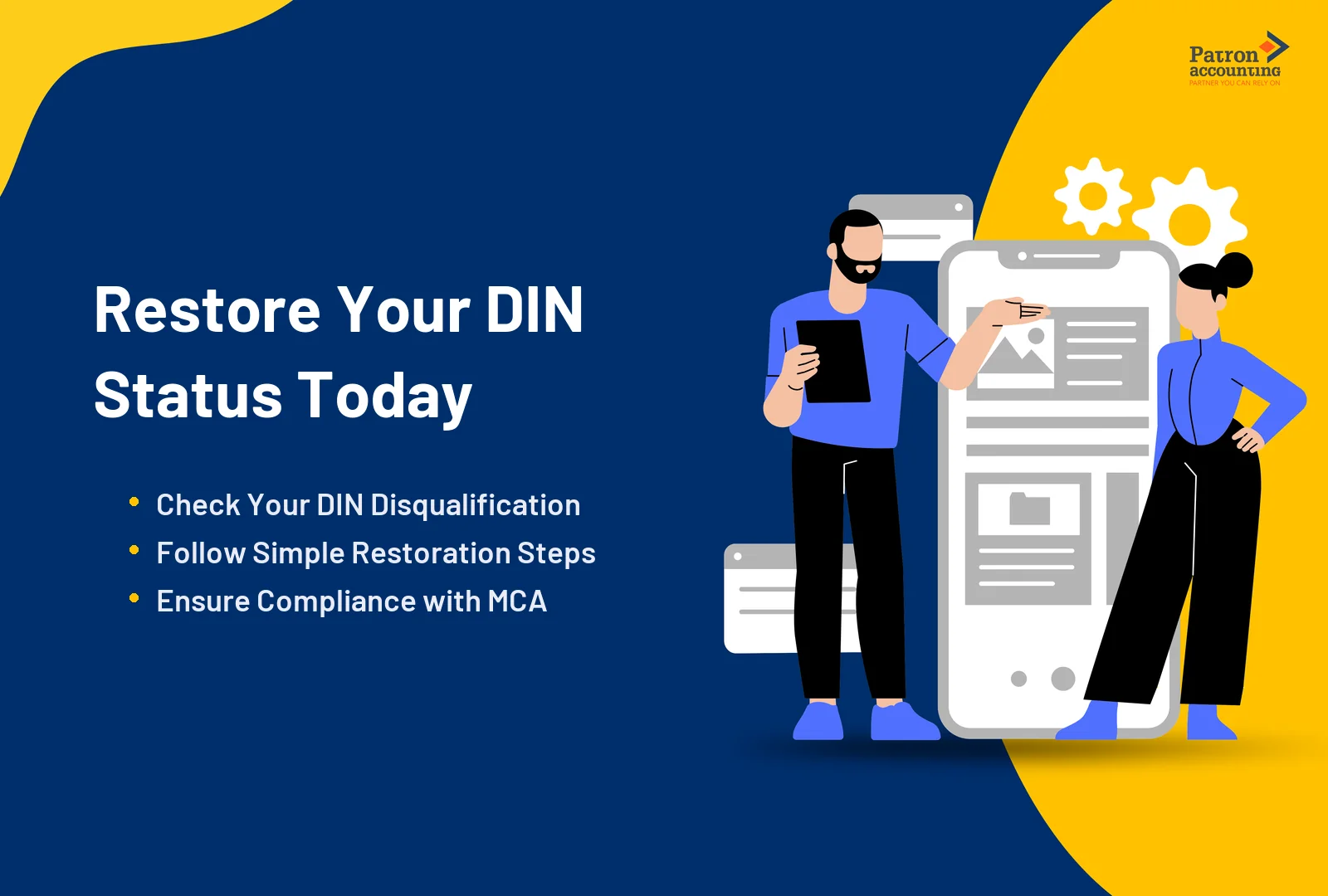
You tried to file a form on the MCA portal and the system rejected it because your DIN is flagged as 'Disqualified.' Or you discovered your name on the MCA's published list of disqualified directors - alongside over 3 lakh others flagged since 2017. Either way, you need to understand exactly what happened, confirm your status, and know the step-by-step process to restore it.
This guide is a practical walkthrough for directors who have been disqualified or suspect they might be. It covers how to check your DIN status on the MCA portal, the specific triggers under Section 164 that lead to disqualification, the exact 5-year timeline, and the three available restoration pathways - filing pending returns, approaching the NCLT, or filing a writ petition in the High Court.
What Is DIN Disqualification and Why Does It Happen?
DIN disqualification means the deactivation of a director's Director Identification Number by the ROC, rendering the individual ineligible to hold or be appointed to any directorship in any Indian company. It is triggered under Section 164 of the Companies Act, 2013 when the director or the company they serve fails to meet specific statutory obligations.
The DIN is the unique identifier that every director must hold under Section 153. When the ROC flags the DIN as 'Disqualified,' the director cannot sign any MCA forms, file any returns, or be appointed to any new company. The disqualification is publicly visible on the MCA portal and the published disqualified directors list.
Directors who have maintained their Director KYC filing and ensured their companies file annual returns on time are protected from this provision. The disqualification is not automatic - it requires a specific default to persist for 3 consecutive years.
Key Terms You Should Know
- Section 164(1): Personal disqualification grounds - unsound mind, undischarged insolvency, criminal conviction (6+ months imprisonment), court order, unpaid share calls, conviction under Section 188 (related party transactions).
- Section 164(2): Corporate default disqualification - triggered when the company fails to file financial statements (AOC-4) or annual returns (MGT-7/MGT-7A) for 3 consecutive financial years, or fails to repay deposits/interest/debentures for 1+ year.
- Section 167: Vacation of office - once disqualified under Section 164, the director must vacate office in ALL companies except the defaulting company itself.
- Form DIR-8: Declaration by a director about their disqualification status under Section 164. Must be filed before appointment or reappointment. Amended in 2023.
- Form DIR-9: Filed by the company to ROC within 30 days of receiving DIR-8 or within 30 days of the default that triggers Section 164(2), furnishing names and addresses of all directors.
- DIN De-flagging: The process by which MCA removes the 'Disqualified' flag from a director's DIN after the 5-year disqualification period expires and compliance is restored.
- NCLT Restoration: Application under Section 252 to restore a struck-off company to active status, which is a prerequisite for restoring the directors' DINs in many cases.
Who Can Be Disqualified Under Section 164?
Section 164 applies to every individual who holds or seeks to hold a directorship in any company registered under the Companies Act, 2013. The disqualification impacts:
- Directors of private limited companies that have not filed AOC-4 or MGT-7/MGT-7A for 3 consecutive years
- Directors of public companies with the same filing defaults - subject to the same 3-year non-filing trigger
- Directors of OPCs - the sole director's DIN is flagged if the OPC's filings are pending for 3 years
- Directors of dormant or inactive companies - these are prime candidates for disqualification because founders often assume no filing is needed
- Directors of companies that failed to repay deposits, interest, or redeem debentures for 1 or more years
- Nominee directors and independent directors - Section 164(2) does not distinguish between executive and non-executive directors; all directors on the board at the time of the default are affected
Companies that maintain timely annual compliance for private limited companies eliminate the risk of Section 164(2) disqualification entirely.
Section 164(1) vs Section 164(2): Two Tracks of Disqualification
Understanding the distinction between the two sub-sections is critical because the triggers, timelines, and remedies differ significantly:
| Parameter | Section 164(1) - Personal | Section 164(2) - Corporate Default |
|---|---|---|
| Trigger | Individual's personal conduct (insolvency, conviction, court order, unpaid calls) | Company's failure to file returns for 3 consecutive FYs or repay deposits for 1+ year |
| Who Is Affected | The individual director only | ALL directors on the board of the defaulting company |
| Disqualification Period | Varies - conviction: 5 years from sentence expiry; insolvency: until discharge | 5 years from the date ROC flags the DIN |
| Vacation of Office | Vacates office in the company where default occurred | Vacates office in ALL companies except the defaulting company |
| Can Shareholder Rights Continue? | Yes - shareholding is unaffected | Yes - shareholding is unaffected |
| Remedy | Address the personal ground (discharge insolvency, complete sentence, pay calls) | File pending returns + DIR-3 KYC; NCLT restoration if company is struck off; HC writ petition |
| MCA List Published | Yes | Yes - MCA publishes ROC-wise lists periodically |
| Form Requirements | DIR-8 (declaration before appointment) | DIR-8 (director) + DIR-9 (company to ROC within 30 days) |
How to Check Your DIN Status and Restore It: Step-by-Step Process
- Check your DIN status on the MCA V3 portal. Log in to the MCA portal (mca.gov.in) and navigate to 'Check Director DIN Status' under the MCA Services section. Enter your DIN and verify whether the status shows 'Approved' (active) or 'Disqualified.' Additionally, search the MCA Disqualified Directors List published at mca.gov.in under Data and Reports > Disqualified Directors. This list includes DIN, director name, CIN, company name, and disqualification period.
- Identify the defaulting company and the specific default. If disqualified under Section 164(2), identify which company's non-filing triggered the disqualification. Check the company's filing history on the MCA portal - look for 3 consecutive years of missing AOC-4 or MGT-7. This determines the restoration path: if the company is still active, pending returns can be filed directly; if the company is struck off, NCLT restoration is needed first.
- File all pending annual returns and financial statements. If the company is active, appoint new directors (if all existing directors are disqualified) using their DIN and DSC to file the overdue AOC-4 and MGT-7 forms. Pay the Rs 100/day additional fees for each delayed form. Once all pending returns are filed, the ROC's system begins processing the de-flagging of disqualified DINs.
- Apply for NCLT restoration if the company is struck off. If the company's status is 'Struck Off' under Section 248, file an application with the NCLT under Section 252 for restoration. The NCLT requires the company to file all pending returns, clear all statutory dues and penalties, and demonstrate that the company was carrying on business at the time of strike-off. The NCLT issues a restoration order, and the ROC updates the company's status to 'Active.'
- Complete DIR-3 KYC for DIN reactivation. After the company is restored and all pending returns are filed, each disqualified director must file DIR-3 KYC (or DIR-3 KYC-WEB) to reactivate their DIN. The MCA processes the KYC and de-flags the DIN from 'Disqualified' to 'Approved.' This is the final step in the technical restoration process.
- Alternatively, file a writ petition in the High Court. If the disqualification was imposed without proper procedure, or if the company's returns were actually filed but the MCA system incorrectly flagged the DIN, a writ petition under Article 226 of the Constitution can be filed in the jurisdictional High Court. The Gujarat, Madras, Karnataka, and Allahabad High Courts have granted relief in multiple cases. The Mumbai High Court, however, has been more restrictive.
- Comply with Form DIR-8 before any future appointment. Under Rule 14 (amended in 2023), every director must file Form DIR-8 declaring their disqualification status before being appointed or reappointed. Companies that process the appointment of director process must verify DIR-8 compliance for each incoming director.
Documents Needed for DIN Restoration
- DIN number and MCA portal login credentials
- Company CIN and filing history printout from MCA portal
- All pending Form AOC-4 (financial statements) for each defaulting year
- All pending Form MGT-7 or MGT-7A (annual returns) for each defaulting year
- Proof of payment of Rs 100/day additional fees for each delayed form
- Form DIR-3 KYC with updated address, email, and Aadhaar/PAN details
- NCLT application (if company is struck off) with prescribed fee and supporting affidavits
- Latest audited financial statements and balance sheet for the NCLT hearing
- Written consent of new directors (Form DIR-2) if appointing new directors to file pending returns
- NOC from creditors if applicable for NCLT restoration under Section 252
- Writ petition draft (if approaching High Court) with supporting documents and prayer for DIN reactivation
Director Disqualification Timeline: From Default to Restoration
The following timeline shows how Section 164(2) disqualification unfolds and how restoration works:
| Stage | Timeline | What Happens |
|---|---|---|
| Default begins | Year 1 of non-filing | Company misses AOC-4 or MGT-7 for the first year. No disqualification yet. |
| Default continues | Year 2 of non-filing | Second consecutive year of non-filing. ROC may issue notices. No disqualification yet. |
| Disqualification triggers | Year 3 of non-filing | Third consecutive year - Section 164(2) is triggered. ROC flags all directors' DINs. |
| DIN deactivated | Immediately after flagging | DIN status changes to 'Disqualified' on MCA portal. Directors cannot sign forms or be appointed anywhere. |
| Vacation of office | Immediately | Directors vacate office in all companies EXCEPT the defaulting company (Section 167). |
| 5-year bar period | 5 years from flagging date | Directors cannot be appointed in any company. Name appears on MCA disqualified list. |
| De-flagging eligible | After 5 years | MCA begins processing DIN de-flagging. Directors must file DIR-3 KYC to complete reactivation. |
| Early restoration | Any time during bar | File pending returns + DIR-3 KYC (active company); or NCLT restoration + returns (struck-off company); or HC writ petition. |
Note: In 2017, MCA disqualified approximately 3.09 lakh directors across India for non-compliance with Section 164(2). The Condonation of Delay (COD) Scheme 2018 provided a temporary window (January to April 2018) for companies to file overdue returns by paying Rs 30,000 plus statutory fees. Directors who did not avail the COD Scheme remained disqualified for the full 5-year period.
Common Mistakes When Dealing with Director Disqualification
Mistake 1: Assuming resignation before disqualification protects you. Resignation filed after the 3-year non-filing period has already elapsed does not prevent disqualification. Section 164(2) applies to directors who were on the board DURING the period of default, not just those currently serving. The MCA flags all directors who held office during the 3 consecutive default years.
Mistake 2: Filing only the company's pending returns without DIR-3 KYC. Filing overdue AOC-4 and MGT-7 is necessary but not sufficient. Each disqualified director must separately file DIR-3 KYC to reactivate their DIN. Without KYC, the DIN remains flagged even after all company-level returns are filed.
Mistake 3: Not acting on inactive companies where you are a director. Many professionals hold directorships in multiple companies. If even one of those companies stops filing for 3 years, ALL directors - including those who are fully compliant in their other companies - get disqualified. Regularly audit all your directorships on the MCA portal.
Mistake 4: Ignoring the struck-off company and hoping the DIN auto-restores. If the defaulting company has been struck off under Section 248, the directors' DINs will NOT be automatically restored even after 5 years. The company must first be restored via NCLT under Section 252, then pending returns filed, and then DIR-3 KYC completed. Consider our guide on the company closure process if the company genuinely has no business purpose left.
Consequences of Director Disqualification Under Section 164
Director disqualification carries consequences that extend far beyond the immediate DIN deactivation.
Under Section 164(2), the disqualified director is barred from being appointed or reappointed as a director in any company - not just the defaulting company - for a period of 5 years from the date the ROC flags the DIN. This includes new incorporations where the director is proposed as a first director.
Under Section 167(1)(a), the director must vacate office in every company where they hold a directorship, except the defaulting company itself. This means a director who is fully compliant in Company A but has a default in Company B will lose their position in Company A - a devastating consequence for professionals holding multiple board seats.
The director's name is published on the MCA Disqualified Directors List, which is publicly accessible. This visibility can impact the director's professional reputation, ability to secure bank loans in a personal capacity, and eligibility for government contracts or tenders. Banks and financial institutions routinely check DIN status before processing credit applications.
However, the disqualified director continues to be a shareholder of all companies. Disqualification affects the directorship role only - not membership or ownership rights.
How DIN Disqualification Connects with Company Status and Future Appointments
DIN disqualification creates a web of interconnected compliance challenges. The director's DIN status is linked to the company's filing status on the MCA portal - if the company resolves its defaults, the director's path to restoration opens. If the company is struck off, the director must first restore the company via NCLT before their own DIN can be addressed. For a comprehensive understanding of the legal framework, see our guide on the complete Section 164 disqualification framework.
The 2023 amendment to the Companies (Appointment and Qualification of Directors) Rules introduced revised Form DIR-8 and Form DIR-9. DIR-8 now requires every director to specifically declare whether they have been disqualified under Section 164 or Section 167, and whether any company in which they held directorship has been struck off. This tightened declaration means that any concealment of disqualification status is itself a compliance violation.
For companies seeking to appoint new directors - whether to replace disqualified directors or to expand the board - the incoming director's DIN status must be verified on the MCA portal before filing Form DIR-12. If the proposed director has any active disqualification, the form will be rejected. This verification step has become an essential part of due diligence for every directorship appointment.
Three Restoration Pathways Compared: Filing Returns vs NCLT vs High Court
| Parameter | File Pending Returns | NCLT Restoration (Section 252) | High Court Writ (Article 226) |
|---|---|---|---|
| When to Use | Company is still 'Active' on MCA | Company is 'Struck Off' | Disqualification was procedurally incorrect or unjust |
| First Step | Appoint new directors; file overdue AOC-4 + MGT-7 | File NCLT application with prescribed fee and documents | File writ petition with supporting evidence |
| Cost | Rs 100/day per form (additional fees) + statutory fees | NCLT fee + pending returns + penalties | Court fees + advocate fees |
| Timeline | 2-4 weeks for filing; MCA processing 1-3 months | 3-12 months for NCLT order | 2-12 months (varies by court) |
| DIN Reactivation | After returns are filed + DIR-3 KYC completed | After NCLT restoration order + returns filed + DIR-3 KYC | Court order directs MCA to reactivate DIN |
| Success Rate | High (if all returns are properly filed) | High (if company had genuine business and all dues are cleared) | Varies - Gujarat, Madras, Karnataka HCs have been supportive; Mumbai HC more restrictive |
Key Takeaways
Director disqualification under Section 164(2) is triggered when a company fails to file annual returns or financial statements for 3 consecutive financial years - affecting ALL directors on the board during the default period, not just the managing director.
The disqualification results in a 5-year bar from directorship in any company, DIN deactivation, vacation of office in all companies except the defaulting one, and public listing on the MCA Disqualified Directors List.
To check DIN status, search the MCA portal's DIN status checker or the published disqualified directors list at mca.gov.in under Data and Reports.
Restoration requires filing all pending returns (AOC-4, MGT-7/MGT-7A) for the defaulting company, paying Rs 100/day additional fees, and completing DIR-3 KYC. If the company is struck off, NCLT restoration under Section 252 must be obtained first.
A disqualified director continues to be a shareholder - disqualification affects the directorship role only. However, the published disqualification impacts professional reputation, credit applications, and future board appointments across all companies.
Need Help Checking or Restoring Your Director Status?
Discovering that your DIN is flagged as disqualified requires immediate action - from identifying the defaulting company and filing overdue returns to completing DIR-3 KYC and, if necessary, applying for NCLT restoration. Each step has its own timeline, fee structure, and documentation requirement.
Explore our compliance and restoration support for end-to-end assistance with DIN reactivation, pending return filing, NCLT applications, and ongoing compliance management.