In this guide
Your company missed its AOC-4 and MGT-7 deadlines. The additional fees are piling up at Rs 100 per day per form. The ROC has issued a notice. Directors are staring at Section 164(2) disqualification. You need a remedy - not just to file the overdue returns, but to formally regularise the delay and resolve any prosecution risk.
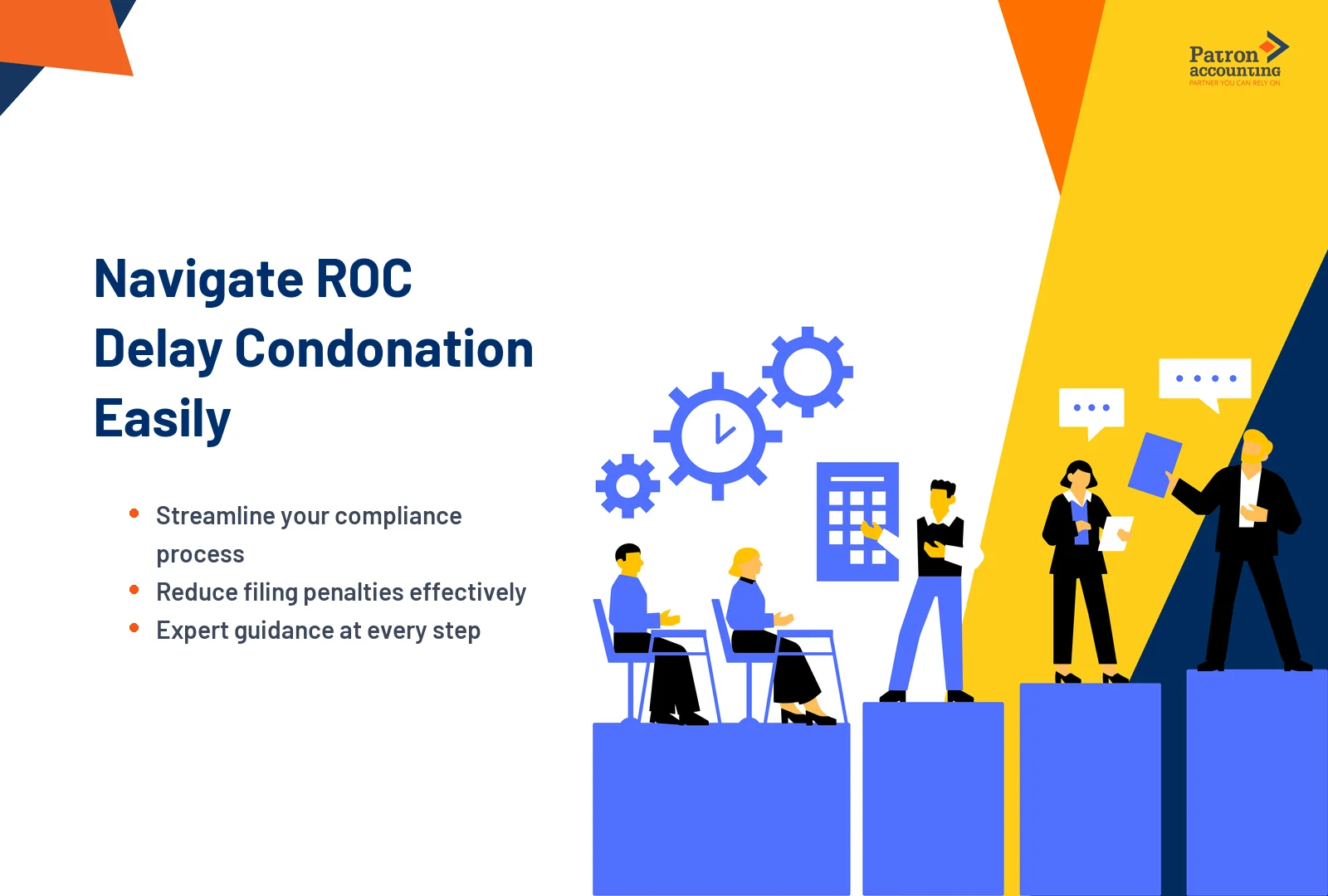
Indian company law provides three distinct remedial pathways: paying additional fees and filing late (Section 403), seeking condonation of delay from the Central Government (Section 460), and compounding the offence through the Regional Director or NCLT (Section 441). This guide explains when to use each remedy, the exact process, the forms required, and how MCA's periodic schemes like CCFS-2026 can dramatically reduce the cost of compliance restoration.
What Are the Three Remedies for Delayed ROC Filings?
Remedy 1: Filing with Additional Fees (Section 403) - the most common route. You file the overdue form on the MCA portal and pay Rs 100 per day per form as additional fee. No upper cap. No separate application needed. The form is processed by the ROC after fee payment. This does not provide immunity from prosecution - it only removes the filing default.
Remedy 2: Condonation of Delay (Section 460) - the Central Government formally pardons the delay. This is used for forms that cannot be filed late with additional fees alone, or where formal condonation is needed for regulatory purposes (e.g., change of object clause, restoration filings). Filed via Form CG-1 with MCA. For a detailed understanding of how penalties accumulate before you seek condonation, see our guide on ROC late filing penalties and CCFS-2026.
Remedy 3: Compounding of Offences (Section 441) - settling the offence by paying a fine instead of facing criminal prosecution. This applies when the ROC has already initiated or could initiate prosecution for the filing default. Filed with the Regional Director (if max fine ≤ Rs 5 lakh) or NCLT (if max fine > Rs 5 lakh).
Key Terms You Should Know
- Section 460: Empowers the Central Government to condone delay in filing any application or document with the ROC beyond the prescribed time. Corresponds to Section 637B of the Companies Act, 1956.
- Section 441: Allows compounding of offences punishable with fine only, or with fine and imprisonment (but not imprisonment only). The offence is settled by payment of a compounding fee instead of prosecution.
- Section 403: Prescribes additional fees for late filing - Rs 100 per day per form with no upper cap. Filing with additional fees is separate from condonation.
- Form CG-1: The MCA e-form used to file applications with the Central Government, including condonation of delay applications under Section 460.
- Form INC-28: Filed with ROC after the Central Government passes the condonation order. Contains the order copy and allows the ROC to process the delayed filing.
- Regional Director (RD): Exercises compounding jurisdiction when the maximum fine for the offence does not exceed Rs 5 lakh. Faster process than NCLT.
- NCLT: Exercises compounding jurisdiction when the maximum fine exceeds Rs 5 lakh. Application filed in Form NCLT-9 under Rule 88 of NCLT Rules.
- CCFS-2026: Company Compliance Facilitation Scheme 2026 - MCA's latest amnesty scheme allowing companies to file overdue returns with only 10% of the normal additional fee, available until 15 July 2026.
Who Needs Condonation of Delay or Compounding?
These remedies apply to any company or director facing consequences of delayed or non-filed ROC forms:
- Companies that have not filed AOC-4, MGT-7, or other statutory forms beyond the prescribed deadline
- Directors facing Section 164(2) disqualification due to 3 consecutive years of non-filing
- Companies restored from struck-off status via NCLT (Section 252) that need to file all overdue returns
- Companies where the ROC has issued a show-cause notice or initiated prosecution proceedings
- Companies that need to file specific forms where late filing is not automatically permitted (e.g., change of object clause)
- Companies seeking to regularise compliance gaps identified during statutory audit or secretarial audit
Companies that maintain timely annual compliance for private limited companies never need these remedies - prevention is always cheaper than cure.
Condonation vs Additional Fees vs Compounding: Understanding the Three Pathways
These three remedies are often confused. Here is how they differ:
| Parameter | Additional Fees (Section 403) | Condonation (Section 460) | Compounding (Section 441) |
|---|---|---|---|
| Purpose | Remove filing default by paying penalty fees | Formal pardon of delay by Central Government | Settle prosecution risk by paying compounding fee |
| When Used | Most late filings (AOC-4, MGT-7, DIR forms) | Forms that cannot be filed late; regulatory regularisation | When ROC has initiated or may initiate prosecution |
| Authority | ROC / MCA portal (automatic) | Central Government | RD (fine ≤ Rs 5 lakh) or NCLT (fine > Rs 5 lakh) |
| Cost | Rs 100/day per form (no cap) | Form CG-1 fee + statutory fee for delayed form | Compounding fee as determined by RD/NCLT |
| Form Required | No separate form - pay on MCA portal | Form CG-1 → Order → Form INC-28 | NCLT Form 9 / RD application |
| Prosecution Immunity | No - prosecution risk remains | No - only pardons the delay | Yes - compounding settles the offence; no prosecution |
| Prerequisite | None | Board resolution + reasons for delay | Offence must be compoundable; no imprisonment-only offence |
| Timeline | Immediate (file and pay) | 2-6 months for CG order | 1-6 months (RD faster, NCLT longer) |
How to Apply for Condonation of Delay Under Section 460: Step-by-Step
- Pass a Board Resolution authorising the condonation application. The Board must approve filing Form CG-1 with the Central Government and authorise a director, CFO, or Company Secretary to sign and submit the application. The resolution should cite Section 460 and specify the forms for which condonation is sought.
- Prepare the application with reasons for delay. Draft a detailed application explaining the genuine reasons for the delay - change in management, illness, system failures, NCLT restoration, or administrative oversight. Attach supporting documents. Companies can engage ROC notice and compliance services for professional assistance with the application.
- File Form CG-1 on the MCA V3 portal. Upload the application with all attachments to the MCA portal using Form CG-1. Pay the applicable fee. The form does not require specific attachments by default, so upload the application, board resolution, and supporting documents as optional attachments.
- Await the Central Government's order. The Central Government examines the application and, if satisfied with the reasons, passes an order condoning the delay. This typically takes 2-6 months. The order must record reasons in writing - a requirement under Section 460 itself.
- File the condonation order with ROC in Form INC-28. After receiving the Central Government's order, file it with the ROC using Form INC-28 along with the prescribed fee. The ROC registers the order and places it in the company's document file for public inspection.
- File the delayed form with the SRN of Form INC-28. Finally, file the delayed application or document on the MCA portal, referencing the SRN of Form INC-28. The ROC processes the delayed filing based on the condonation order.
Documents Needed for Condonation and Compounding Applications
- Certified true copy of Board Resolution authorising the application
- Application letter with detailed reasons for delay and relief sought
- Form CG-1 (for condonation) or NCLT Form 9 (for compounding) with prescribed fee
- Copy of the delayed form or document for which condonation is sought
- NCLT restoration order (if the company was restored from struck-off status)
- Proof of payment of additional fees already paid under Section 403
- Audited financial statements and balance sheet for the relevant period
- Affidavit of the authorised representative (for NCLT compounding applications)
- Memorandum of appearance / Vakalatnama (for NCLT proceedings)
- ROC show-cause notice or prosecution notice (if applicable for compounding)
- Copy of previous compounding orders (if any - to verify the 3-year repeat default rule)
Compounding of Offences Under Section 441: Who Decides and What It Costs
Compounding jurisdiction depends on the maximum fine prescribed for the offence:
| Parameter | Regional Director (RD) | NCLT |
|---|---|---|
| Jurisdiction | Maximum fine for the offence ≤ Rs 5 lakh | Maximum fine for the offence > Rs 5 lakh |
| Application Form | Application to RD with prescribed documents | NCLT Form 9 (Annexure A) under Rule 88 of NCLT Rules |
| Compounding Fee | As determined by RD - typically lower than NCLT | As determined by NCLT - can impose minimum fine or less |
| Timeline | 1-3 months typically | 3-6 months depending on NCLT bench |
| Effect | Offence is settled; no prosecution | Offence is settled; no prosecution |
| Repeat Default Rule | Cannot compound if same offence was compounded within last 3 years | Same - Section 441(2) explanation applies |
| Cannot Compound | Imprisonment-only offences; investigation pending under the Act | Same restrictions apply |
| Key NCLT Precedent | N/A | UW International: minimum fine not mandatory; NCLT can admonish or warn |
Note: Under Section 451, any default that has been previously compounded and is repeated within 3 years attracts mandatory imprisonment for the second offence. The 3-year clock resets after each compounding. Additionally, under Section 441(2) explanation, a second offence committed after 3 years from the previous compounding is deemed a first offence - meaning it can be compounded again.
Common Mistakes When Seeking Condonation or Compounding
Mistake 1: Assuming condonation is a prerequisite for late filing. Condonation under Section 460 is a separate process - it does not prevent you from filing overdue forms with additional fees under Section 403. You can file immediately by paying the Rs 100/day fee. Condonation is needed only for specific forms that cannot be filed late or for regulatory regularisation.
Mistake 2: Filing a compounding application for an imprisonment-only offence. Section 441 explicitly excludes offences punishable with imprisonment only. Offences punishable with both fine and imprisonment can be compounded, but the imprisonment portion is resolved through the compounding process. Check the penalty clause of the relevant section before applying.
Mistake 3: Attempting to compound a repeated offence within 3 years. If the same offence was compounded within the last 3 years, it cannot be compounded again under Section 441(2). The second offence must go through prosecution with enhanced penalties under Section 451. Companies should address the root compliance failure - see our guide on director disqualification under Section 164 for the downstream consequences.
Mistake 4: Not using MCA amnesty schemes when available. MCA periodically introduces schemes like CCFS-2026 that reduce additional fees to 10% of normal. Companies that file during the scheme window save up to 90% on penalties. Ignoring these schemes and filing after they expire means paying the full Rs 100/day with no discount.
What Happens If You Don't Seek Condonation or Compounding
Failing to address delayed ROC filings through any remedial pathway leads to escalating consequences.
Under Section 403, additional fees of Rs 100 per day per form accumulate with no upper cap. For a company that has not filed AOC-4 and MGT-7 for 3 years, the additional fee alone can exceed Rs 2,19,000.
Under Section 454, the ROC can initiate adjudication proceedings, imposing penalties of Rs 50,000 to Rs 5,00,000 on the company and Rs 10,000 to Rs 1,00,000 on each officer in default. These are on top of the additional fees.
Under Section 164(2), non-filing for 3 consecutive years triggers director disqualification for 5 years, affecting all directorships held by the individual - not just the defaulting company.
Under Section 248, persistent non-filing can lead to the company being struck off by the ROC, with remaining assets vesting in the Central Government. Directors of struck-off companies face additional disqualification.
How Condonation and Compounding Connect with Other Compliance Obligations
Condonation and compounding do not exist in isolation - they are part of a broader compliance remediation ecosystem. When a company is restored from struck-off status via NCLT under Section 252, it must file all overdue returns. MCA has historically introduced specific condonation schemes (like the December 2020 scheme) for restored companies, waiving additional fees on overdue filings made pursuant to NCLT restoration orders. For a comprehensive view of filing requirements, see our guide on annual compliance requirements for companies.
Compounding under Section 441 directly impacts the company's compliance record in the secretarial audit report (Form MR-3) and the annual return certification (Form MGT-8). If delay is not condoned or the offence is not compounded, the auditor must report this as a qualification, which affects the company's credibility with banks, investors, and regulatory bodies.
The Corporate Laws (Amendment) Bill, 2026 proposes further decriminalisation of minor filing offences and may introduce a reduced additional fee structure to replace the current Rs 100/day regime. Until the Bill is enacted, companies should use the available remedies - additional fees, condonation, compounding, and MCA schemes - to regularise their compliance position as early as possible.
Which Remedy Should You Use? A Practical Decision Framework
| Your Situation | Recommended Remedy |
|---|---|
| Filed late but no prosecution threat | Pay additional fees under Section 403 and file immediately. No condonation needed. |
| Form cannot be filed late on MCA portal (e.g., change of object clause) | Apply for condonation under Section 460 via Form CG-1. Obtain order, file Form INC-28, then file the delayed form. |
| ROC has issued a show-cause notice or prosecution notice | Apply for compounding under Section 441 to the RD (fine ≤ Rs 5 lakh) or NCLT (fine > Rs 5 lakh). |
| Company restored from struck-off via NCLT Section 252 | File all overdue returns with additional fees. Check if MCA has an active condonation scheme for restored companies. |
| MCA amnesty scheme (CCFS-2026) is currently active | File all overdue returns during the scheme window - pay only 10% of normal additional fees. |
| 3 consecutive years of non-filing - directors disqualified | File overdue returns + DIR-3 KYC to reactivate DINs. Consider compounding if prosecution has been initiated. |
| Same offence was compounded within last 3 years | Cannot compound again. Face prosecution with enhanced penalties under Section 451. Engage legal counsel. |
Key Takeaways
Section 460 empowers the Central Government to condone delay in filing any application or document with the ROC beyond the prescribed time. The application is filed via Form CG-1, and the condonation order is filed with the ROC in Form INC-28.
Condonation of delay is NOT a prerequisite for late filing - companies can file overdue forms by paying additional fees under Section 403 (Rs 100/day per form) without seeking condonation. Condonation is a separate, independent process.
Compounding under Section 441 settles an offence by paying a fine instead of facing prosecution. The Regional Director handles cases where the maximum fine is Rs 5 lakh or less; NCLT handles cases where the maximum fine exceeds Rs 5 lakh.
Offences punishable with imprisonment only, repeat offences compounded within the last 3 years, and offences under investigation cannot be compounded. After 3 years, a repeat offence is deemed a first offence and can be compounded again.
MCA periodically introduces amnesty schemes (COD 2018, CFSS 2020, CCFS-2026) that dramatically reduce additional fees - the CCFS-2026 scheme offers 90% reduction. Companies should always check for active schemes before filing overdue returns at full penalty rates.
Need Help with Condonation of Delay or Compounding Applications?
Navigating condonation under Section 460 and compounding under Section 441 requires understanding which remedy applies to your specific situation, preparing detailed applications with supporting evidence, and managing timelines across MCA, Regional Director, and NCLT. A wrong choice or incomplete application can delay resolution by months.
Explore our compliance remediation support for end-to-end assistance with condonation applications, compounding petitions, overdue return filing, and DIN reactivation.