
Incorporation
LLP Registration in India
A limited liability partnership lets two or more people run a business together the way partners do, while keeping their personal assets separate from the business's debts. We prepare the documents, file the incorporation application on the MCA portal, draft and file the LLP agreement, and stay with you until the LLP is ready to trade.

- Who it is for Two or more people running a business together as partners
- How you apply Online, through the MCA's integrated LLP incorporation form (FiLLiP)
- What you receive A certificate of incorporation with the LLP identification number (LLPIN)
- After incorporation The LLP agreement is signed and filed with the Registrar
The short answer
LLP registration at a glance
LLP registration is the process of forming a limited liability partnership under the Limited Liability Partnership Act, 2008, by filing an online application with the Registrar through the Ministry of Corporate Affairs (MCA) portal. Once the Registrar approves it, the LLP receives a certificate of incorporation and becomes a legal person separate from its partners.
- Governing law
- Limited Liability Partnership Act, 2008 and the LLP Rules, 2009
- Partners
- At least 2
(the Act sets no maximum: Section 6) - Designated partners
- At least 2 individuals, one of them resident in India
(two designated partners who are individuals, one resident in India: Section 7) - Minimum capital
- No minimum contribution is set by the law
- How you apply
- Online, through the MCA's integrated LLP incorporation form (Form FiLLiP, which covers name reservation and LLP incorporation)
- What you receive
- A certificate of incorporation with the LLP identification number (LLPIN)
- After incorporation
- The LLP agreement is filed with the Registrar within a set time
(Form 3, within 30 days of incorporation) - Government fee
- Depends on the partners' total contribution
(set by contribution under Annexure A to the LLP Rules, 2009; we confirm the current amount from the MCA fee schedule before filing) - Our fee
- Starting from ₹2,999 (Exl GST and Govt. Charges)
Between two forms
What is a limited liability partnership?
A limited liability partnership (LLP) is a business form that sits between a partnership firm and a company.
That means an LLP can own property, open bank accounts, sign contracts and sue or be sued in its own name. If the business runs into debt, the creditors deal with the LLP, not with the partners' homes or savings, unless a partner has acted fraudulently.
An LLP is different from an ordinary partnership firm. A partnership firm under the Indian Partnership Act, 1932 is not separate from its partners, and every partner is personally liable for the firm's debts without limit. If you want the simpler partnership route, see our Partnership Firm Registration service.
Key terms you will see
- Partner
- Any person or body corporate that joins the LLP under the LLP agreement.
- Designated partner
- A partner who is responsible for the LLP's legal filings and compliance. Every LLP needs at least two, and they must be individuals. (two designated partners who are individuals, one resident in India: Section 7)
- DPIN / DIN
- The identification number given to each designated partner. A director's DIN works as a DPIN. A designated partner who has neither applies for a DPIN in the FiLLiP form itself.
- FiLLiP
- The Form for incorporation of Limited Liability Partnership: the single web form that applies for incorporation and, where needed, the name and DPINs. It also issues DPINs to proposed designated partners who do not have one.
- LLP agreement
- The written agreement between the partners that sets out their rights, duties, profit shares and contributions. It is filed with the Registrar after incorporation. (Form 3, within 30 days of incorporation)
- LLPIN
- The LLP's identification number, shown on its certificate of incorporation.
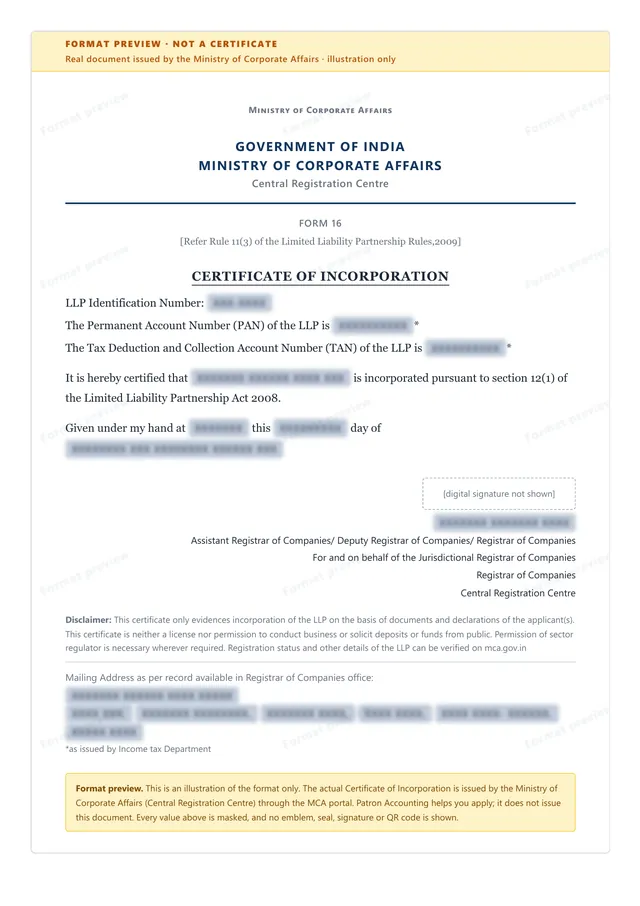
See a sample
Certificate of Incorporation of an LLP
The certificate that registers the LLP. It shows the LLP name, its LLPIN and the date of incorporation.
- Issued by
- Ministry of Corporate Affairs (Central Registration Centre)
- When you get it
- Once the incorporation application is approved.
Values hidden for privacy. Names, numbers and dates are covered. Your own document carries your details.
Download Certificate of Incorporation of an LLP sample (PDF) View Certificate of Incorporation of an LLP sample
Is it right for you?
Who should register an LLP?
An LLP can be formed for any lawful business carried on for profit. Section 11 of the LLP Act, 2008: two or more persons associated for carrying on a lawful business with a view to profit. It suits:
- Professional practices. Consultants, architects, designers and other professionals who work as partners and want limited liability. Some regulated professions have their own rules on whether and how they may practise through an LLP, check with your professional body first.
- Small businesses with two or more founders who want limited liability but do not plan to sell shares to investors.
- Family businesses and joint ventures where the partners want a written agreement, clear profit shares and a separate legal entity, with less formality than a company.
- Existing partnership firms that want limited liability. A partnership firm can convert into an LLP under the LLP Act; that is a separate service. (the application is made in Form 17 under the LLP Rules, 2009)
- NRIs and foreign nationals who want to be partners in an Indian business. Non-residents can be partners, but at least one designated partner must be resident in India. Foreign investment in an LLP must follow the foreign direct investment rules for the sector.
An LLP needs at least two designated partners who are individuals, one of them resident in India, a stay of at least 120 days in the financial year (LLP Act, Section 7). Foreign investment in an LLP is on the automatic route only where the sector is open to 100% FDI with no FDI-linked performance conditions. An LLP with foreign investment may not be in agricultural or plantation activity, print media or real estate business: Consolidated FDI Policy of 15 October 2020.
An LLP can also apply for startup recognition after incorporation, if it meets the conditions of the startup scheme.
Requirements in short
| Requirement | Detail |
|---|---|
| Partners | Minimum 2; individuals or bodies corporate (the Act sets no maximum: Section 6) |
| Designated partners | Minimum 2 individuals, at least one resident in India (two designated partners who are individuals, one resident in India: Section 7) |
| Age | Partners who sign must be adults able to contract |
| Contribution | No legal minimum; the partners agree it in the LLP agreement |
| Partner identity | Each designated partner needs a DPIN (or DIN) and a digital signature certificate (DSC) (the DPIN can be applied for in the FiLLiP form) |
| Registered office | An address in India where the LLP receives post (proof of the office address, with the owner's no-objection where it applies, and a utility bill not older than two months, MCA FiLLiP instruction kit) |
| Name | Unique, not misleading, ending with "LLP" or "Limited Liability Partnership" |
What we do
Our LLP registration services
- Digital signatures We arrange a digital signature certificate for each designated partner from a licensed certifying authority, so the forms can be signed online.
- Name check and reservation We check your proposed names against the LLP and company registers and the trade mark register, suggest alternatives and apply for the name. (an approved name stays reserved for 3 months)
- Incorporation filing We prepare and file FiLLiP with the Registrar (partner details, DPINs for new designated partners, the registered office and the professional's certification) and follow it up until the certificate is issued.
- LLP agreement We draft the agreement to fit your business: contributions, profit shares, decision-making, admission and exit of partners, and what happens on a dispute. We then file it with the Registrar. The LLP agreement is filed in Form 3 within 30 days of incorporation.
- PAN and TAN We make sure the LLP has its PAN and TAN for tax, bank and payroll purposes. (Form FiLLiP allots the PAN and TAN with the certificate of incorporation)
- First steps after incorporation Opening the bank account, GST registration where your business needs it, and a calendar of the LLP's yearly filings.
Ongoing yearly filings after the LLP is set up are a separate service; see LLP compliance.
Seven steps, two phases
How to register an LLP: step by step
The whole process runs online on the MCA portal. Here is the route most LLPs follow.
- Step 1
Digital signature certificates
Every designated partner needs a digital signature certificate to sign the forms online. We arrange these with you at the start. - Step 2
DPIN for the designated partners
Each designated partner needs a designated partner identification number. A person who already has a DIN as a company director uses it. New designated partners can be given a DPIN through the incorporation form itself, up to a set number; others apply separately. - Step 3
Choose and reserve the name
You give us your name options. We check them against existing LLPs, companies and registered trade marks, then apply through the RUN-LLP service, or within FiLLiP itself. The name must end with "LLP" or "Limited Liability Partnership".
(an approved name stays reserved for 3 months) - Step 4
File the incorporation form (FiLLiP)
FiLLiP carries the LLP's name, the registered office, the partners and designated partners, their contributions, the business activity and the partners' consents. It is signed digitally and certified by a practising professional, then filed with the government fee.
Mandatory attachments include proof of the office address and a utility bill not older than two months; the fee follows the contribution slab in Annexure A to the LLP Rules, 2009. - Step 5
Certificate of incorporation
When the Registrar approves the application, the LLP receives its certificate of incorporation with its LLPIN. The LLP exists from the date on the certificate.
(Form FiLLiP allots the PAN and TAN with the certificate of incorporation)
- Step 6
Draft and sign the LLP agreement
The partners sign the LLP agreement, which is stamped under the stamp law of the state where the registered office is. - Step 7
File the LLP agreement
The agreement is filed with the Registrar online after incorporation. Filing late attracts an additional fee.
The LLP agreement is filed in Form 3 within 30 days of incorporation.
Who gives what
Documents required for LLP registration
From every partner
- PAN card Every Indian partner. Used to verify identity on the MCA portal
- Aadhaar or other identity proof Passport, voter ID or driving licence also accepted for identity
- Address proof (recent bank statement, electricity, phone or mobile bill) We tell you how recent it must be
- Passport-size photograph Plain background
- Passport NRI and foreign partners. Documents signed abroad may need notarisation or apostille (MCA: notarised in Commonwealth countries; notarised and apostilled in Hague Convention countries; notarised and authenticated by the Indian embassy elsewhere)
From every designated partner
- Digital signature certificate Arranged by us
- Consent to act as designated partner Drafted by us (Form 9)
From the LLP and all partners
- Registered office proof Utility bill or property tax receipt; if rented, the rent agreement and a no-objection letter from the owner
- LLP agreement All partners. Drafted by us, signed after incorporation
If a partner is a company or another LLP, we also need its board resolution (or partners' resolution) and the identity of the person who will represent it. We send a checklist at the start that matches your partners and your office, so you collect only what applies.
Where applications slip
Common challenges and how we handle them
| Challenge | What it causes | How we handle it |
|---|---|---|
| Name refused as too similar | A fresh name application and lost time | We check names against the LLP, company and trade mark registers before applying, and keep back-up names ready |
| Documents that do not match | The Registrar returns the form when names or addresses differ between PAN, Aadhaar and address proof | We compare every partner's documents before filing and help partners correct mismatches first |
| Portal errors during filing | A form that fails validation or must be re-submitted | We check the form against the documents before upload and handle any re-submission with you |
| LLP agreement filed late | An additional fee | We draft the agreement while the incorporation is in progress, so it is ready to sign as soon as the certificate arrives |
| Foreign partners' documents | Delays while documents are attested abroad | We send the attestation steps up front for each country involved |
See all our company incorporation services.
What it costs
LLP registration fees
The professional fee depends on the number of partners, whether any partner is a non-resident, a foreign national or a body corporate, the state of the registered office and how much drafting the LLP agreement needs. Fees shown are indicative and not a binding offer.
What the total cost of registering an LLP is made of:
| Cost | Paid to | Amount |
|---|---|---|
| Name reservation (RUN-LLP) | Ministry of Corporate Affairs | ₹200 (MCA RUN-LLP instruction kit) |
| Incorporation form (FiLLiP) | Ministry of Corporate Affairs | Set by contribution under Annexure A to the LLP Rules, 2009; we confirm the current amount from the MCA fee schedule before filing |
| Filing the LLP agreement | Ministry of Corporate Affairs | Confirmed in your written quote |
| Stamp duty on the LLP agreement | The state government | Varies by state; in some states it depends on the partners' contribution. |
| Digital signature certificates | A licensed certifying authority | Confirmed in your written quote |
| Professional fee | Patron Accounting | Starting from ₹2,999 (Exl GST and Govt. Charges) |
Timing
How long does LLP registration take?
The time depends on how quickly the digital signatures are issued, whether the first name is approved, how complete the documents are and how long the Registrar takes to process the application.
What speeds it up:
- name options checked in advance, with back-ups,
- every partner's documents scanned and matching each other,
- a registered office proof that matches the address exactly,
- the LLP agreement terms agreed between the partners early, and
- quick digital signing when the forms are ready.
We give you a dated plan when we start and tell you at once if the Registrar raises a query.
Six reasons
Benefits of an LLP
- 1. Limited liability. Each partner's risk is limited to their agreed contribution, unless they act fraudulently. (Sections 27, 28 and 30 of the LLP Act, 2008)
- 2. Separate legal identity. The LLP owns its assets and signs its own contracts.
- 3. Perpetual succession. Partners can join or leave without the LLP coming to an end.
- 4. Flexible internal rules. The partners decide in the LLP agreement how profits are shared and how decisions are made. There are no board meetings or shareholder meetings to hold.
- 5. Lighter compliance than a company. An LLP files a yearly statement of accounts and solvency and an annual return. Its accounts need an audit only above the limits set in the LLP rules. (an audit is compulsory only when turnover is above ₹40 lakh and contribution is above ₹25 lakh, LLP Rules, rule 24(8))
- 6. Taxed as a firm. For income tax an LLP is taxed as a firm, and partners' shares of profit are not taxed again in their hands. An LLP is taxed at 30% of total income, plus surcharge and cess where they apply (tax year 2026-27, Income-tax Act, 2025); a partner's share of profit is exempt in the partner's hands.
The trade-off is that an LLP cannot issue shares, so it does not suit founders who want equity investors or employee stock options.
Side by side
LLP vs private limited company
If you plan to raise money from investors or give employees a stake, look at Private Limited Company Registration. If you are a single founder, a One Person Company gives limited liability with one owner.
Where the rules come from
How we check this page
This page explains the law as it stood on the date below.
- Written and reviewed byWritten by CS Aashima Goyal · reviewed by Subham Jhunjhunwala
Sources
- Companies Act, 2013, sections 2(68) and 149(3), as published on India Code (the private limited company column of the comparison)
Six questions
Frequently asked questions
How do I register a business as an LLP?
An LLP is not a company: it is a separate kind of body formed under the LLP Act. To register one, get digital signatures for the designated partners, reserve a name, file the FiLLiP incorporation form on the MCA portal with the partners' documents and the registered office proof, and, once the certificate of incorporation is issued, sign and file the LLP agreement. You need at least 2 partners, with at least 2 designated partners, one of them resident in India.
An LLP needs at least two designated partners who are individuals, one of them resident in India, a stay of at least 120 days in the financial year (LLP Act, Section 7).
What are the steps of incorporation?
For an LLP: digital signatures, designated partner numbers, name reservation, the incorporation form, the certificate of incorporation, then the LLP agreement signed and filed. The step-by-step section above explains each one.
How much time does it take to form an LLP?
It depends on the digital signatures, the name approval, how complete the documents are and the Registrar's processing. The LLP agreement is filed after incorporation, within the time the rules allow. We give you a dated plan when we start.
What is Form 9 in LLP incorporation?
Form 9 is the consent of a partner to act as a designated partner. Each designated partner signs it, and it is filed with the incorporation application. We draft it for you; there is nothing to download.
Which form is filed after LLP incorporation?
The LLP agreement is filed with the Registrar after incorporation, using the form for information about the LLP agreement. After that, the regular yearly filings are the statement of accounts and solvency and the annual return.
Each year Form 11 is due by 30 May and Form 8 by 30 October.
How much stamp paper is needed for an LLP agreement?
Stamp duty on an LLP agreement is set by the state where the registered office is, and in some states it depends on the partners' contribution. We confirm the duty for your state before the agreement is signed, and many states accept e-stamping.
Get a quote
Register your LLP with us
Tell us your proposed names, the number of partners and designated partners, whether any partner lives outside India or is a company, each partner's contribution and the state of your registered office. We will confirm the documents you need, the government charges for your state and our fee, and agree a plan through to the filed LLP agreement.
Patron professional fee: Starting from ₹2,999 (Exl GST and Govt. Charges)
Get a quote
Leave your details and we will call you back.
By sending this form you agree to our privacy policy.
Call us
What to tell us
- Your proposed names
- The number of partners and designated partners
- Whether any partner lives outside India or is a company
- Each partner's contribution
- The state of your registered office